
Adults & Senior Adults
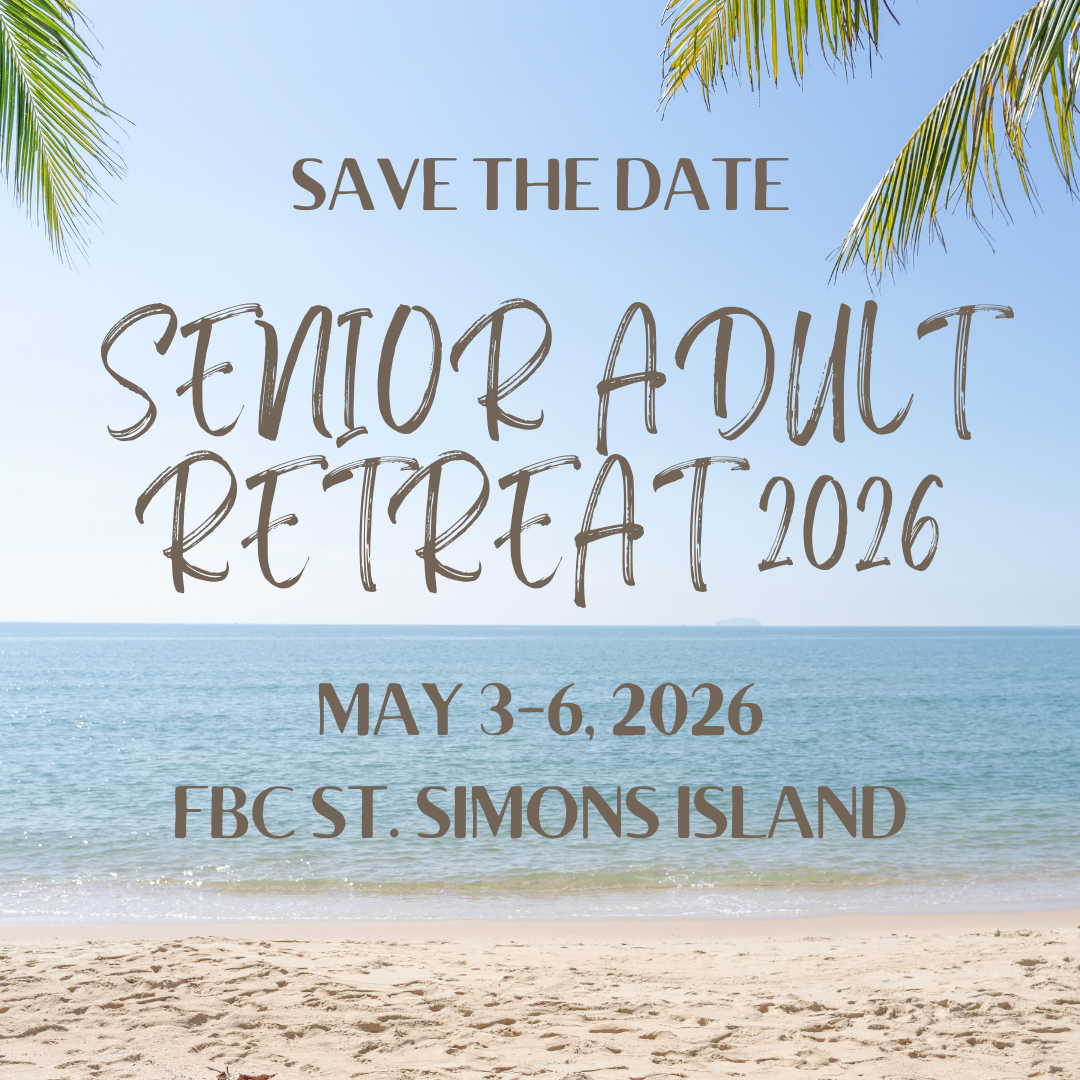
Senior Adult Retreat is a yearly event for Senior Adults who are still “Young at Heart!” Seniors worship, sing, attend breakouts, eat and enjoy free time with their friends, old and new. Breakouts range from learning the rules of Pickleball to tips on how to stay safe on the web! Join us this year in May!
Where: FBC St. Simons Island
When: May 3-6, 2026
Date: Sunday Evening, May 3 – Wednesday Lunch, May 6, 2026
Place: First Baptist Church, St. Simons Island
Retreat Cost: $50/Person (includes two lunches and two fellowships)
Lodging Suggestions
Suggested hotels and accommodations, along with Airbnb and VRBO, include:
Best Western Plus SSI (912-638-7805)
Hampton Inn SSI (912-634-2204)
Holiday Inn Express (912-634-2175)
Home2Suites (912-638-0333)
There may also be some availability at Epworth-by-the-Sea (912) 290-6777.
Very Tentative Retreat Schedule
Sunday, May 3:
7:00 – 8:30 p.m. – Evening Check-in, First Baptist Church, Saint Simons
Monday, May 4:
9:00 a.m. – Morning Celebration in Sanctuary
9:45 a.m. – 10:30 a.m. – Breakout Session #1
10:45 a.m. – 11:30 a.m. – Breakout Session #2
11:45 a.m. – Lunch and Learn
12:45 p.m. – 7:00 p.m. – Free Time and dinner on your own
7:00 p.m. – 8:00 p.m. – Worship
8:00 p.m. – 9:00 p.m. – Cake Fellowship and Entertainment
Tuesday, May 5:
9:00 a.m. – Morning Celebration in Sanctuary
9:45 a.m. – 10:30 a.m. – Breakout Session #3
10:45 a.m. – 11:30 a.m. – Breakout Session #4
11:45 a.m. – Lunch
12:45 p.m. – 7:00 p.m. – Free Time and dinner on your own
7:00 p.m. – 8:00 p.m. – Worship
8:00 p.m. – 9:00 p.m. – Ice Cream Fellowship and Entertainment
Wednesday, May 6:
9:30 a.m. – Fellowship and coffee in Fellowship Hall
10:00 a.m. – Closing Worship and Communion in Sanctuary
11:00 a.m. – Depart for home
If you need information please email Rachel Greco at rgreco@cbfga.org or call/text (478) 538-5000.

Recent Posts
Latest News
Sing Together by Jody Long
As long as I can remember, music has been a part of what being a Baptist means to me. The small church I grew up in was a “singing” church. We did not have classically trained musicians or even a professional minister of music. We did not have a pipe organ or a grand piano. We did not even have choir robes. What we did have, though, was a deep love of Jesus and a song in our hearts to sing about his love.
It was in the pews and, sometimes, in the choir loft of that church that I was first exposed to theology — a way of talking about God. The church songs of my childhood are probably ones that resonate with most of us who have been a part of a church for some time. Granted, my church preferred the more revivalistic hymns, but “Amazing Grace,” “Just As I Am,” and “How Great Thou Art” were staples in our repertoire, lifted almost exclusively from the 1975 Baptist Hymnal published by Broadman Press.
In their comprehensive book, I Will Sing the Wondrous Story: A History of Baptist Hymnody in North America, David Music and Paul Richardson write:
Throughout much of their history, the worship of Baptist churches has been centered upon the activities of preaching and congregational singing. The hymns Baptists have sung, and the books from which they have sung them, have been important shaping forces for the theology, worship, and piety of the denomination. (p.1)
When four of our Rome-area CBFGA-partner churches invited me to come to their hymn festival in early February, I knew I had to be there. “Sing Together” was an afternoon of wonderfully good music, led by passionate ministers of music, sung by a talented mass choir. Selections of hymns and anthems, combined with thoughtful reflections upon the music by the pastors of the four churches, made for an afternoon of true worship.
The real power in an event like “Sing Together,” though, rests not so much in the music but in the gathering itself. It is no secret that our broader society is becoming more fractured and segmented by the day. Nearly a quarter century ago, Robert Putnam wrote one of the salient books of our time, Bowling Alone: The Collapse and Revival of American Community. Putnam, a social scientist at Harvard University, noted that throughout its history, America has waxed and waned in its commitment to developing and maintaining communal life. At the time of his writing, he noted American society was in a declining trend:
For the first two-thirds of the twentieth century a powerful tide bore Americans into ever deeper engagement in the life of their communities, but a few decades ago — silently, without warning — that tide reversed and we were overtaken by a treacherous rip current. Without at first noticing, we have been pulled apart from one another and from our communities over the last third of the century. (p. 27)
Many of the partner churches of the Cooperative Baptist Fellowship of Georgia face these troubling and disruptive headwinds. Political polarization, the continued effects of the global COVID pandemic, and a general religious malaise in America, have leapt headfirst into most churches. The easiest response to such unwanted intrusion is to close the doors of our buildings and our hearts, sequestering ourselves from others out of fear, disgust, or distrust. None of that seems to be the way Jesus would have us respond, though. As I often say, on our best days, CBFGA lives out its name: we are a Fellowship of Baptists in Georgia who voluntarily and joyfully Cooperate together.
CBFGA will continue to encourage churches and other partner ministries never to give up cooperating together, working alongside each other for the good of our communities and for the sake of the Gospel of Jesus Christ. We will continue to promote and support gatherings of our partner congregations in service and fellowship. If your church or churches in your area want to connect, fellowship, and serve alongside each other and you need some help making such things happen, please do not hesitate to reach out to our office! If your church does not make connecting with other churches — especially other CBFGA partner churches — a priority, I encourage you to do so.
We are better individually, we are better congregationally, we are better organizationally when we live, work, and love together. The hymn “The Servant Song” says it best: “We are travelers on a journey, fellow pilgrims on the road; we are here to help each other walk the mile and bear the load.” May it ever be so!
2022 State Gathering Report
Over 130 CBFGA folks gathered at First Baptist Church, Augusta, November 6-7 to fellowship, worship, and seek a way forward as we considered the theme “God’s Story, Your Story, My Story.” Through compelling sermons by Dr. Chuck Poole, and in engaging conversations facilitated by Dr. Dave Odom, we looked hard at some of the difficulties our churches and ministers have faced through the COVID-19 pandemic, focusing on what it means to be a neighbor in these times.
Dr. Poole led in two worship experiences, first on Sunday evening with a message entitled, “God’s Story and Ours,” in which he challenged us to start with the big story —God’s story — and then figure out where we fit into that story, so that God’s story becomes our story. Our job, he said, is to “get in on what God is doing, by drawing our circle wider and wider and wider, as wide as the circle of welcome around God.” On Monday, in “Your Story and Mine,” Dr. Poole reflected on his own story, of his painful process of learning to draw that circle of welcome wider and wider, especially as it relates to encouraging and supporting women in ministry. Challenging us to claim our stories, Dr. Poole urged listeners to let the Holy Spirit help us to reach back and bless the best from our past, while reaching forward to “draw our circle of love wide, as wide as God’s circle of love, in every direction.”
That theme, of drawing the circle wide, segued nicely into enthusiastic table discussions with Dave Odom leading, as participants explored a series of questions prompted by the pandemic. A three-person panel representing different-sized churches in varied contexts helped facilitate the conversation in the first two sessions. The panelists were Suzanne Hooie, Minister of Missions and Spiritual Formation at First Baptist Church, Dalton; Dock Hollingsworth, Senior Pastor of Second-Ponce de Leon Baptist Church in Atlanta; and Christian Burton, Pastor of The Oaks Baptist Church in Lyons.
Questions considered during the three discussion sessions included:
SESSION ONE: Please describe your congregation’s neighborhood. What age, living conditions, work, and families? How does your congregation learn from and about your neighbors? How does your congregation stay in touch with the neighbors? What is staying the same and what is changing for your neighbors?
SESSION TWO: What ministries with neighbors has the church expanded or started during and beyond the lockdown period of COVID? How does your church determine success or know that you need to adjust? What have you learned about your leadership and the leadership of others during the last few years?
SESSION THREE: What are the questions frequently on the minds of your members?…your neighbors? Where do you start? What is a next most faithful step?
After hearing from the panel, each table continued the conversation, and conversation was lively! Particularly helpful was the discussion of how a church’s definition of “neighbor” may have changed in the past couple of years, and what reaching out to our neighbors means now. The ideas were as varied as the contexts of the churches represented. Suzanne told how her church has become involved more deeply and differently with its neighbors in Dalton by focusing on food insecurity in nearby areas, by taking Vacation Bible School to children in one area, and by moving from “check-writing” to deeply involved hands-on ministry. Christian spoke of his church renewing its 9/11 Mission Day, of doing simple acts as a church, meeting as best they can what people need. Sometimes figuring out what people need is the challenge, he admits. Dock discussed the challenge of “redeeming the space we have,” of finding new and innovative uses for his church’s expansive space. When asked how their churches determine success or know that they need to adjust, all three panelists said they are still trying to figure that out! All agreed that we as churches often are still caught in “the counting world,” but Suzanne said that “COVID gave us permission to break the measuring stick” and to try new ideas and even to fail. That session concluded with helpful discussion of what we have learned about our leadership and the leadership of others during these years.
Other highlights of the gathering included a question-and-answer dialogue with Paul Baxley, Executive Coordinator of CBF Global. He gave positive reports on an increase in this year’s Global Missions Offering and the possibility of naming new field personnel fairly soon, after several years’ pause. He also addressed the recent State of Women in Baptist Life report, noting that while we do well encouraging women to respond to God’s call, we are not calling them often enough to be pastors; he describes this as an integrity problem and called for churches and search committees to rise to the challenge to change the situation. We are living through a time, Baxley says, when all the foundations are shifting, but we have the assurance that God is at work giving boldness, courage, and agility.
The CBFGA Lancaster Scholars were recognized during dinner on Sunday evening, as was BWIM of Georgia’s Sarah Owen Ethridge scholarship recipient, Maggie Parker Andrews.
First Baptist Church, Augusta, provided excellent space and warm hospitality and worship leadership for the meeting, and we thank them for their support and careful planning.
Next year’s State Gathering will happen November 12-13,2023, at Central Baptist Church in Newnan.